| [First Hit] |
|---|
 Click to view presentation in PDF format.
 Carbonate Porosity and Its Application to Reservoir
Characterization*
Carbonate Porosity and Its Application to Reservoir
Characterization*Search and Discovery Article #40357 (2008)
Posted October 24, 2008
*Adapted from oral presentation at AAPG Annual Convention, San Antonio, TX, April 20-23, 2008.
1 Department of Geology, Texas A&M University, College Station, TX. ([email protected])
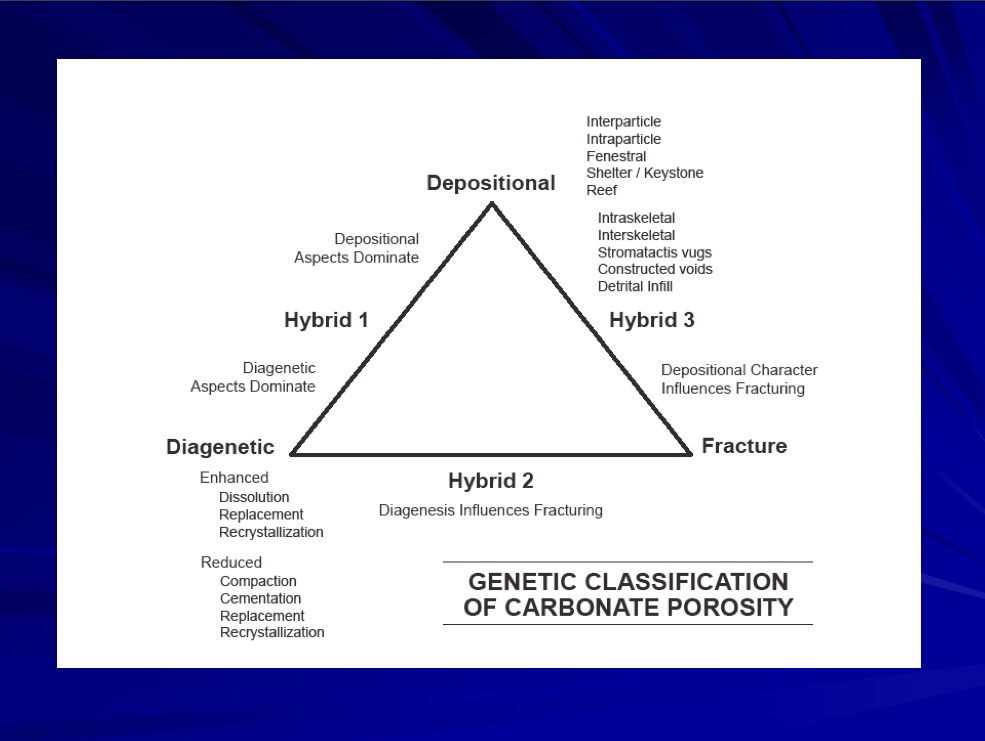
Carbonate pore types are formed by depositional, diagenetic, or fracture processes such that
the spatial distribution of porosity may or may not conform to depositional facies boundaries. Pores may be
formed or altered by diagenesis and brittle fracture. Understanding carbonate porosity requires identifying pore
characteristics that reflect the processes that created them. It requires determining how genetic pore types are
related to petrophysical characteristics and how pore-forming processes have influenced bulk-rock properties.
Genetic pore types are part of a larger collection of rock properties formed by the three
end-member processes; consequently, genetic pore types must have characteristics that correspond to petrological
or stratigraphic attributes that serve as "tags" for the genetic pore types. Examples of "tags" may include
unconformities, paleosols, evaporite horizons, predictable occurrences in stratigraphic cycles, or distinctive
geochemical, fluid inclusion, and cathode luminescence signatures. Such tags may be recognizable in cores and
thin sections, on outcrops, in sequence stratigraphic "stacking patterns", on wireline logs, and in seismic
signatures.
If the mode and time of origin of the "tags" can be identified, it is then possible to predict the spatial distribution of the corresponding genetic pore types. Rock properties that correspond to genetic pore types can be put in larger stratigraphic context for use in reservoir characterization, flow unit mapping, and reservoir modeling.
Genetic classification identifies rock properties and covariant genetic pore types
"bundled" by common origin. Knowing cause-effect origin of pores, pore/rock-type bundles are mappable at field
scale; e.g., diagenesis associated with unconformities, fractures associated with structural geometry,
depositional pore systems associated with facies boundaries. The classification facilitates improved reservoir
definition, flow unit mapping, and petrophysical rock typing based on pore type and pore/pore throat geometry
instead of "facies type".
Baceta, J.I., V.P. Wright, P.S.J. Beavington, and V. Pujalte, 2007, Palaeohydrogeological
control of palaeokarst macro-porosity genesis during a major sea-level lowstand: Danian of the Urbasa-Andia
plateau, Navarra, North Spain: Sedimentary Geology, v. 199/1-4, p. 141-169.
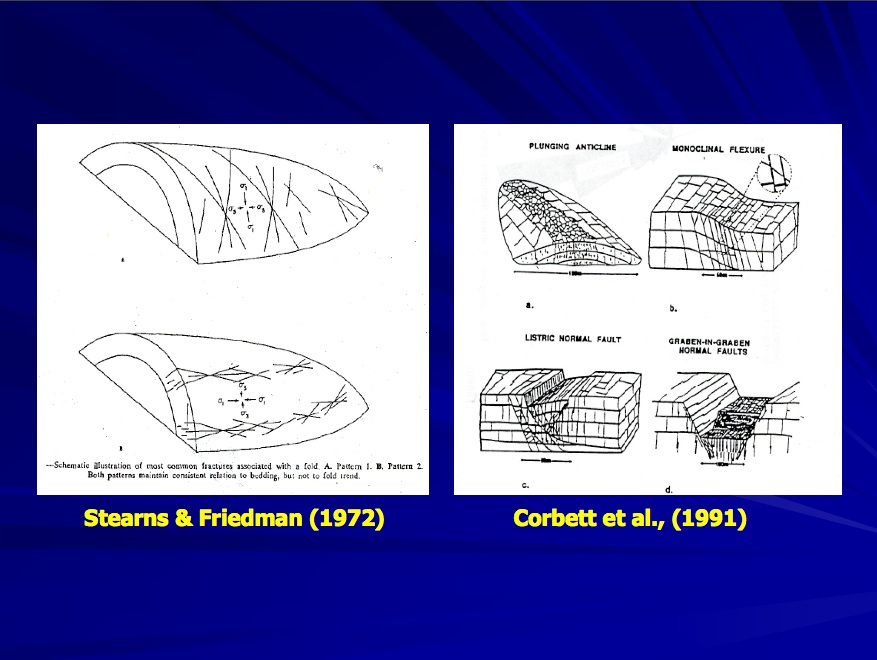
Corbett, K.P., M. Friedman, D.V. Wiltschko, and J.H. Hung, 1991, Controls on fracture development, spacing, and geometry in the Austin Chalk Formation, central Texas: considerations for exploration and production: Dallas Geological Society Field Trip #4, 49 p.
Loucks, R.G., 1999, Paleocave carbonate reservoirs; origins, burial-depth modifications, spatial
complexity, and reservoir implications: AAPG Bulletin, v. 83, p. 1795-1835.
Machel, H.G., 2004, Concepts and models of dolomitization; a critical reappraisal, The Geometry and Petrogenesis of Dolomite Hydrocarbon Reservoirs: GS (London) Special Publication 235, p. 7-63.
Stearns, D.W., and M. Friedman, 1972, Reservoirs in fractured rock, in Stratigraphic Oil and Gas Fields; Classification, Exploration Methods, and Case Histories: AAPG Memoir 16, p. 82-106.
Winland, H.D., 1976, Evaluation of gas slippage and pore aperture size in carbonate and
sandstone reservoirs: Amoco Production Company Report F76-G-5, 25p. (unpublished).
and
sandstone reservoirs: Amoco Production Company Report F76-G-5, 25p. (unpublished).