|
uAbstract
uFigure
captions
uIntroduction
uStratigraphy
uOrganic
 geochemistry geochemistry
uBurial
history
uPetroleum
potential
uSource
rocks
uExpulsion
timing
uReservoirs
uTraps/seals
uProspective
areas
uConclusions
uAcknowledgments
uReferences
uAbstract
uFigure
captions
uIntroduction
uStratigraphy
uOrganic
geochemistry
uBurial
history
uPetroleum
potential
uSource
rocks
uExpulsion
timing
uReservoirs
uTraps/seals
uProspective
areas
uConclusions
uAcknowledgments
uReferences
uAbstract
uFigure
captions
uIntroduction
uStratigraphy
uOrganic
geochemistry
uBurial
history
uPetroleum
potential
uSource
rocks
uExpulsion
timing
uReservoirs
uTraps/seals
uProspective
areas
uConclusions
uAcknowledgments
uReferences
uAbstract
uFigure
captions
uIntroduction
uStratigraphy
uOrganic
geochemistry
uBurial
history
uPetroleum
potential
uSource
rocks
uExpulsion
timing
uReservoirs
uTraps/seals
uProspective
areas
uConclusions
uAcknowledgments
uReferences
uAbstract
uFigure
captions
uIntroduction
uStratigraphy
uOrganic
geochemistry
uBurial
history
uPetroleum
potential
uSource
rocks
uExpulsion
timing
uReservoirs
uTraps/seals
uProspective
areas
uConclusions
uAcknowledgments
uReferences
uAbstract
uFigure
captions
uIntroduction
uStratigraphy
uOrganic
geochemistry
uBurial
history
uPetroleum
potential
uSource
rocks
uExpulsion
timing
uReservoirs
uTraps/seals
uProspective
areas
uConclusions
uAcknowledgments
uReferences
uAbstract
uFigure
captions
uIntroduction
uStratigraphy
uOrganic
geochemistry
uBurial
history
uPetroleum
potential
uSource
rocks
uExpulsion
timing
uReservoirs
uTraps/seals
uProspective
areas
uConclusions
uAcknowledgments
uReferences
uAbstract
uFigure
captions
uIntroduction
uStratigraphy
uOrganic
geochemistry
uBurial
history
uPetroleum
potential
uSource
rocks
uExpulsion
timing
uReservoirs
uTraps/seals
uProspective
areas
uConclusions
uAcknowledgments
uReferences
uAbstract
uFigure
captions
uIntroduction
uStratigraphy
uOrganic
geochemistry
uBurial
history
uPetroleum
potential
uSource
rocks
uExpulsion
timing
uReservoirs
uTraps/seals
uProspective
areas
uConclusions
uAcknowledgments
uReferences
uAbstract
uFigure
captions
uIntroduction
uStratigraphy
uOrganic
geochemistry
uBurial
history
uPetroleum
potential
uSource
rocks
uExpulsion
timing
uReservoirs
uTraps/seals
uProspective
areas
uConclusions
uAcknowledgments
uReferences
|
The
Devonian succession in southern and southwestern New Mexico has a long
history of stratigraphic study (e.g., Nelson, 1940; Stevenson, 1945;
Laudon and Bowsher, 1949; Kottlowski et al.,1956; Pray, 1961; Kottlowski,
1963; Rosado, 1970; LeMone, 1982, 1996; Sarouf, 1984; Day, 1988, 1998);
however, only a limited number of reports place the complex facies into
a regional context (Kottlowski, 1963; Bowsher, 1967; Raatz, 2002) or
discuss organic geochemistry and thermal history (Broadhead, 2002). This
report updates and re-evaluates stratigraphic data and integrates
organic geochemistry, burial history, and other aspects relevant to the
Devonian System’s hydrocarbon potential. Table 1 lists named well and
outcrop locations used in the study, with numbers keyed to locations in
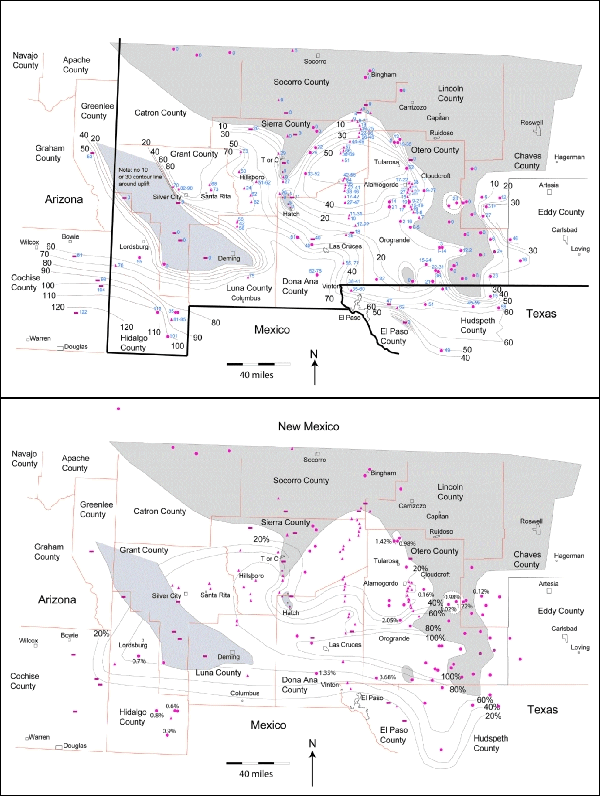
Figure 1. A total of 151 locations were used to construct a Devonian isopach map (Figure 2), and from those data points with sufficient
information available, a Percent Black Shale map (Figure 3) was
generated; the latter is also shown with posted Total Organic Carbon
(TOC) data (Figure 4). Burial History models were constructed for the
Grim Mobil-32 #1 well in southern Dona Ana County and the McGregor GDP
51-8 well in southwestern Otero County (Figures 5,
6, 7, and
8).
The
Middle to Upper Devonian formations present in southern New Mexico
unconformably overlie the Silurian Fusselman Formation and underlie
Mississippian units. They are composed of thin, locally fossiliferous gray to brown shales, siltstones, sandstones,
carbonates, and barren anoxic black shales. In the San Andres and
Sacramento mountains, Devonian strata representing largely shelf
environments can be grossly divided into two major unconformity-bounded
packages: the Givetian clastic-dominated Oñate Formation and the upper
Frasnian-Famennian mixed clastic/carbonate Sly Gap and Contadero
Formations (Day, 1988). Shelf deposits from the Sacramento and San
Andres mountains grade southward into an E-W-trending trough located at
the approximate latitude of Las Cruces containing anoxic, barren black
shales of the Percha Formation (Kottlowski, 1963; Rosado, 1970). Farther
south in the Franklin Mountains the Percha black shales grade into and
are underlain by the Canutillo Formation, a cherty carbonate. To the
west, the black-shale-filled Percha trough widens, extending from
northern Grant and Sierra counties southward to Deming and perhaps into
Mexico. To the far west, beginning approximately at Lordsburg, the
shaley basin facies becomes more sandy and carbonate-rich as it
approaches the shelf areas of Arizona and the boot heel of New Mexico,
correlating to the Portal and Swisshelm formations.
Interpretation of the environment of deposition responsible for the
anoxia and subsequent black shale deposition ranges from shallow lagoon
with algal mat covering (Seager, 1981; LeMone, 1982, 1996b; Mack et al.,
1998), to “deep water” with anoxia resulting from a density-stratified
seaway (Kottlowski et al., 1956; Sorauf, 1984; Day, 1988, 1998). The
“deep water” model better fits the general basin physiography of the
area and is the preferred interpretation. This “black shale problem” is
not restricted to southern New Mexico but is a common interpretive
conundrum throughout Devonian epeiric sea deposits in North America
(e.g., Grabau, 1915; Brown and Kenig, 2001; Sageman and Arthur, 2001).
Devonian formations are well established within individual mountain
ranges, although members continue to undergo revision, and correlation
between ranges is not always clear (see Kottlowski et al., 1956; Seager,
1981; Sorauf, 1984; Kottlowski and LeMone, 1994). The oldest Devonian
strata present in south-central New Mexico may be the Canutillo
Formation (Nelson, 1940) in the Organ/Franklin Mountains. It
unconformably overlies the Fusselman Formation and underlies and is a
partial lateral facies equivalent to the Percha Formation, which in the
southern area includes shaley facies correlative northward to the Oñate
and Sly Gap Formations (Seager, 1981). The Canutillo is composed of a
lower dolomitic siltstone and an upper cherty carbonate. The formation
thins northward from 26 m in the Franklins to 6 m at Bishop Cap to 1 m
in the southern San Andres Mountains. The Oñate Formation (Stevenson,
1945) of the Sacramento and San Andres mountains is of late Givetian age
and unconformably overlies the Fusselman, while to the south in the
Organ/Franklin Mountains its shaley facies is incorporated within the
Percha Formation. In the Sacramento Mountains the Oñate consists of
open-marine shelf deposits composed of gray silty dolomite, dolomitic
siltstone, and minor sandstone with bryozoans, brachiopods, and local
chert (Pray, 1961). It thins from 18 m in the south-central Sacramentos
to 6 m in the far northern and southern reaches of the range (Pray,
1961). In the Hueco Mountains, 32 m of sparsely fossiliferous shales,
silty shales, and silty limestones may correlate to the Oñate, Sly Gap,
and Percha (Kottlowski, 1963). The lower Oñate in the San Andres
Mountains is similar to the Sacramento Mountain sections, augmented in
the central range by nondolomitized wackestones containing corals,
crinoids, brachiopods, and bryozoans. The upper Oñate in the San Andres
Mountains is regressive and clastic-rich, with siltstones, shale, and an
upper cross-bedded sandstone unit documented (Kottlowski et al., 1956;
Sorauf, 1984). The formation thins to the north and south from its
maximum of 26 m in San Andres Canyon, becoming sandier to the north and
shalier to the south.
The Sly
Gap Formation (Stevenson, 1945), of Frasnian age, disconformably
overlies the Oñate (Pray, 1961; Day, 1988). It is present in the
northern and central Sacramento Mountains, the entire San Andres
Mountains, and is incorporated as part of the Percha Formation in the
Organ/Franklin Mountains (Pray, 1961; Seager, 1981; Sorauf, 1984). It is
interpreted to represent a transgressive-regressive succession deposited
in shelf (Sacramento Mountains, northern San Andres Mountains) to basin
(southern San Andres Mountains) environments (Day, 1988). In the
Sacramento Mountains the Sly Gap Formation contains interbeds of
calcareous shale, thin-to-nodular fossiliferous lime mudstone, and
lesser black shale, weathering to a distinctive yellowish color (Pray,
1961). Laudon and Bowsher (1941, 1949), Stevenson (1945), and Pray
(1961) considered various upper beds of black shale in the southern
Sacramento Mountains as belonging to the Percha Formation, although
other workers interpreted them as basin facies of the Sly Gap Formation
(Kottlowski et al., 1956). In the San Andres Mountains the Sly Gap
Formation consists of nodular interbeds of fossiliferous (colonial and
solitary corals, brachiopods, crinoids, ammonoids, gastropods,
stromatoporoids), calcareous, silty shale, silty limestone, and
calcareous siltstone (Kottlowski et al., 1956; Sorauf, 1984; Kottlowski
and LeMone, 1994). In the southern San Andres Mountains the Sly Gap is
composed almost completely of dark gray to black shales deposited in
anoxic environments (Kottlowski et al., 1956; Day, 1988).
The
Contadero Formation (Stevenson, 1945) is recognized in the northern San
Andres Mountains and originally incorporated all strata between the Sly
Gap and the Mississippian, but it was revised by Flower (in Kottlowski
et al., 1956) to include what were originally upper Sly Gap units and
also exclude upper dark shales with Fammenian fauna, which were placed
in the Percha Formation. Sorauf (1984) revised Flower’s member
nomenclature to include: the Salinas Peak Member (sea-level highstand
shale to sandstone, with upper coral-bearing nodular limestone);
Thurgood Sandstone Member (regressive, fine-grained, well indurated
sandstone with calcareous cement and brachiopod fragments); and Rhodes
Canyon Member (Fammenian-aged shales and burrowed siltstones with
brachiopods, correlative to the Ready Pay Member of the Percha
Formation). The Contadero Formation, which is not recognized in the
Sacramento or the Franklin Mountains, may have formed in a narrow
structural re-entrant largely limited to the San Andres Mountains area
(Day, 1988).
In the
Organ/Franklin Mountains the Percha Formation is used to include all
Middle-Upper Devonian shales above the Canutillo Formation, including
strata that are age-equivalent to the Oñate, Sly Gap, and Contadero
formations (Seager, 1981). To the north, when used at all, the Percha is
constrained to only those dark shales of Fammenian age. The Percha is
divided into two members: the Ready Pay (black, fissile, barren shale)
and the Box (shale with nodular limestone concretions and limited
fauna). As discussed, Pray (1961) considered the uppermost dark shales
in the southern Sacramentos to be lower Percha, rather than Sly Gap,
based partly on a dark shale “channel-filling” unit with angular
contacts between the Sly Gap and Mississippian. Dark shales in the
extreme southern Sacramento Mountains are variously interpreted as
Percha or Sly Gap/Oñate basin equivalents (Kottlowski et al., 1956;
Pray, 1961). Fammenian-aged shales in the San Andres Mountains are
included in the Rhodes Canyon Member of the Contadero Formation (Sorauf,
1984).
In
southwestern New Mexico Devonian strata are composed of dark fissile and
carbonaceous shale facies from the basin environment and are considered
the Percha Formation regardless of age. Barren dark shales of the Ready
Pay Member overlie Fusselman carbonates and, in turn, are overlain by
dark green to black calcareous shale with shaley nodular limestones of
the Box Member. Laudon and Bowsher (1949) offer an excellent description
of Devonian stratigraphy and paleontology for this basin facies
throughout the southern and southwestern area.
Organic
geochemistry data for Devonian units in south-central and southwestern
New Mexico is spotty and of varying vintage and quality (New Mexico
Bureau of Geology and Mineral Resources Digital Data Series- Database
DDS-DB2; New Mexico Bureau of Geology (Mines) and Mineral Resources Open
File Reports 92, 153, 202, 206, 237, 263, 328, 362, and 456).
Figure 4
posts public domain Devonian TOC values on a % black shale map. Future
work will focus on expanding this database with respect to both source
rock richness and maturity. data for Devonian units in south-central and southwestern
New Mexico is spotty and of varying vintage and quality (New Mexico
Bureau of Geology and Mineral Resources Digital Data Series- Database
DDS-DB2; New Mexico Bureau of Geology (Mines) and Mineral Resources Open
File Reports 92, 153, 202, 206, 237, 263, 328, 362, and 456).
Figure 4
posts public domain Devonian TOC values on a % black shale map. Future
work will focus on expanding this database with respect to both source
rock richness and maturity.
Burial
history and basin analysis studies are not common for this region. Two
major problems exist in constructing accurate models: (1) data quantity
and quality, and (2) the complex heat-flow history of this area that has
experienced Ancestral Rocky Mountain tectonism, the Laramide orogeny,
and Rio Grande rifting.
Although a fair number of well penetrations exist (Table 1,
Figure 1),
most are of pre-1980 vintage (many significantly older) and contain
generally poor log suites. Detailed bolson thickness data and structural
styles are poorly constrained; lithologies and lithic percentages can
often only be estimated; and formation and age picks are usually
performed without the aid of biostratigraphic data or core. Geochemical
and thermal data are rare.
Estimate of heat flow through time is a major variable in any burial
history model. The Rio Grande Rift area contains one of the more
complicated thermal regimes in the world. High-quality regional present-
day heat flow maps exist (Reiter et al., 1975), but they must smooth
some of the natural heterogeneity derived from spatially complex
intrusions and faults. For example, the regional map (Reiter et al.,
1975) illustrates a heat flow range of 1.4 to 4.7 hfu over the study
area; however detailed local measurements reach as high as 17 hfu
(equates to over 700 mWM/m2; New Mexico Bureau of Geology and Mineral
Resources Open File Report 456). The fact that this area has some of the
best geothermal energy potential in the United States, including a
number of existing successful projects, bespeaks to its high and complex
heat flow.
Even
under ideal circumstances, basin models offer nonunique solutions that
fit known data. Due to the data complexities discussed above, a single
“best estimate” model is misleading for this area, since a greater than
normal number of parameters are poorly constrained. I, therefore,
provide two best fit end member models that hopefully bracket much of
the area (Figures 5, 6,
7, and 8): (1) Grim Mobil-32 #1, a deep well
test below 20,000 feet containing thick Tertiary Rio Grand Rift bolson
valley fill but heat flow within regional norms, and (2) McGregor GDP
51-8, with much thinner bolson deposits but anomalously high heat flow.
Numerous oil and gas shows and one significant gas discovery (Harvey E.
Yates 1Y Bennett Ranch well, Sec. 14, T.26S., R.12E.) in the study area
indicate an active petroleum system exists. Of 83 exploratory wells
drilled in the Tularosa Basin, 25 contain shows. Despite this proven
potential, the area’s large size, the multiple source and reservoir
facies, and the complex structural history offering numerous trapping
mechanisms, few integrated petroleum systems studies have been
undertaken (e.g., Broadhead, 2002). A regional, comprehensive
interpretation of this area’s petroleum system is needed to understand
better its potential and to high-grade primary opportunities.
Source
rocks have been documented for Devonian, Mississippian, Pennsylvanian,
and Permian strata (Broadhead, 2002), and for Cretaceous shales and
coals in central New Mexico. This paper has concentrated on the thick
Devonian black shales, but other units offer viable oil- and gas-prone
source facies in a wide range of thermal maturities. Regional
richness/maturity trends in Devonian strata indicate that the thick
black shale deposits in Hidalgo and Luna counties are of relatively poor
quality and overmature (Thompson, 1981). The area should not be
condemned, however, due to the sparse dataset. The most prospective area
appears to reside in Dona Ana and southern Otero counties. Here,
although black shales are thinner than areas to the southwest,
increasing organic richness and decreasing maturity create a viable,
mixed oil/gas-prone source rock. The shales are interpreted as
predominantly gas-prone due to their low HI values (50-200), visual
kerogen data, S2/S3 ratios less than 5, and generally high thermal
maturities.
For the
Ancestral Rocky Mountain Orogrande and Pedregosa basin areas (e.g.,
central Tularosa Basin between the Sacramento and San Andres Mountains,
and in southwestern New Mexico in Hidalgo and southwest Luna counties)
oil-prone source rocks of Lower Paleozoic and possibly Upper Paleozoic
age became early to moderately mature during Late Pennsylvanian through
Permian time. Outside of the Ancestral Rocky Mountain basin depocenters,
it is less likely thermal maturities reached levels for major expulsion.
It is difficult to ascertain the effect of the Laramide orogeny on the
eastern area since little Mesozoic section is preserved and no detailed
vitrinite profiles have been located in the public domain to quantify
the extent of Mesozoic deposition and subsequent erosion. In the western
area, thick preserved Cretaceous deposits may have caused a second
expulsion event. The Rio Grande Rift, with its elevated heat flows,
igneous intrusions, and thick bolson deposits brought all graben-area
source rocks to maturity or post-maturity, resulting in minor(?) oil and
potentially major gas expulsion beginning ~28 Ma and continuing today.
Horst areas vary from immature to post-mature, depending on the
stratigraphic interval and extent of uplift associated with specific
blocks. It is likely that over the large study area hydrocarbons have
been continually expulsed from Late Paleozoic time until Recent, with
pulses centered around the three major orogenic events.
Numerous potential reservoir facies exist, including: fractured
Precambrian basement, Cambro-Ordovician sandstones (Bliss Formation),
karsted Ordovician carbonates (El Paso Formation), Silurian dolomites (Fusselman
Formation), Devonian sandstones (northern area), Devonian shales
(southern area), Mississippian carbonate bioherms (including large
Waulsortian mounds), Pennsylvanian (Morrowan/Atokan) sandstones, Upper
Pennsylvanian phylloid-algal mounds (correlative to the Holder Formation
outcrops in the Sacramento Mountains), Lower Permian (Wolfcampian) basin
margin mounds and breccia debris flows, Upper Permian (San Andres and
Yeso Formation) backreef limestones and dolomites, Cretaceous sandstones
(Dakota Formation) and coalbed methane, and Tertiary (Eocene) fractured
igneous sills (the major reservoir for the Otero Mesa Harvey E. Yates
gas discovery). Recovered fluids from existing wells include oil, gas,
saline water, and fresh water.
The
large study area has undergone multiple tectonic episodes and also has
numerous documented stratigraphic pinch-outs, creating a wide range of
trapping styles and mechanisms, many analogous to the neighboring
prolific Permian Basin. Ancestral Rocky Mountain block faults, many
reactivated during Rio Grande Rift extension, potentially juxtapose
reservoir facies against units with low permeability or against fault
planes with clay smear/cataclasis effects. Structural roll-on horsts
near major normal faults also add dip closure. Low-angle Laramide thrust
faults and rollovers are documented in outcrop (e.g., Pray, 1961) and
the subsurface; for example, a major thrust-fault-induced rollover was
encountered in the McGregor 51-8 well. Stratigraphic traps include
Devonian shale gas, large biohermal mounds in the Mississippian,
Pennsylvanian, and Permian sections, carbonate debris flows off basin
margins sealed (and potentially sourced) with basinal shales,
Pennsylvanian, and Permian stratigraphic pinch-outs onlapping Ancestral
Rocky Mountain uplifts, Lower Paleozoic pinch-outs of strata onlapping
the Transcontinental Arch, Cretaceous coalbed methane, and fractured
Eocene igneous sills intruded into tight carbonates and shales.
Seal
integrity is a concern in the eastern Sacramento Mountain uplift area.
Major fracture systems have breached some horst block units, flushing
reservoirs with fresh water. This negative does create an opportunity
for fresh-water exploration in this growing, water-starved area.
Integrating previous studies and new work, the most prospective area for
Devonian-sourced hydrocarbons appears to be the south-central portion of
the study area, bounded approximately by the latitudes of Hatch to the
north and El Paso to the south, and longitude of Deming to the west and
extending eastward beyond the study area. This area has adequate organic
richness, thermal maturity, reservoir intervals, and trapping mechanisms
to create a viable petroleum (predominantly gas) system. To the north,
Devonian organic richness lessens, due to the influx of shelf clastics;
to the west source-rock richness decreases, due to unknown reasons and
maturities increase to post mature. To the south richness decreases, due
to a facies change into the cherty carbonate Canutillo Formation.
South-central New Mexico contains the necessary ingredients for economic
discoveries of hydrocarbons sourced by Devonian black shales. Poor data
and a complicated geologic history pose challenges, but continued
studies that focus on quantifying and high-grading local and regional
aspects of the petroleum system will reduce risks and lead to more
exploration activity. Available data, both well and outcrop, have not
yet been utilized to their maximum potential. As part of this ongoing
study, data will be re-evaluated and incorporated into a comprehensive
petroleum systems framework.
PRA
Inc. BasinMod 1-D was used for basin modeling. The New Mexico Bureau of
Geology and Mineral Resources, a Division of New Mexico Institute of
Mining and Technology (New Mexico Tech) provided data and time to
perform this ongoing study.
Bayless, G.S., and Schwarzer, R.R., 1988, Hydrocarbon
source rock evaluation of Houston Oil and Minerals No. 1 Lewelling,
Otero County, New Mexico: New Mexico Bureau of Mines and Mineral
Resources Open-file Report 328.
Bowsher, A.L., 1967, The Devonian System of New Mexico:
Tulsa Geological Society Digest, v. 35, p. 259- 276.
Broadhead, R.F., 2002, Petroleum geology of the McGregor
Range, Otero County, New Mexico: New Mexico Geological Society, 53rd
Field Conference, Guidebook, p. 331-338.
Broadhead, R.R., Wilks, M., Morgan, M., and Johnson, R.E.,
1998, New Mexico Bureau of Geology and Mineral Resources Digital Data
Series Database DDS DB2.
Brown, T.C., and Kenig, F., 2001, Continental scale
intermittent photic zone euxinia during deposition of
Devonian-Mississippian black shales of North America (abs.): Geological
Society of America, Abstracts with Programs, v. 33, no. 6, p. 38.
Day, J.E., 1988, Stratigraphy, biostratigraphy, and
depositional history of the Givetian and Frasnian strata in the San
Andres and Sacramento Mountains of southern New Mexico [Ph.D.
dissertation]: University of Iowa, Iowa City, 253 p.
Day, J.E., 1998, Middle-Late Devonian transgressive-regressive
cycles in cratonic platform and platform-to-basin settings: San Andres
and Sacramento mountains, southern New Mexico (abs.): Geological Society
of America, Abstracts with Programs, v. 30, no.2, p. 13.
Foster, R.W., 1978, Oil and gas evaluation of White Sands
Missile Range and Fort Bliss Military Reservation, south-central New
Mexico: New Mexico Bureau of Mines and Mineral Resources, Open-file
Report 92, 130 p.
Grabau, A.M., 1915, The black shale problem; a study in
Paleozoic geography: Annals of the New York Academy of Sciences 24, p.
378-379.
Jacobson, S.R., Rankin. J.S., and Saxton, J.D., 1983,
Organic geochemical analysis, Houston Oil and Minerals No.2 Lewelling
Well, Otero County, New Mexico: New Mexico Bureau of Mines and Mineral
Resources Open-file Report 206.
Jacobson, S.R., Rankin. J.S., Saxton, J.D., and Ruth, G.W.,
1984, Organic geochemical analysis, Plymouth Oil Co. No. 1 Federal Well,
Otero County, New Mexico: New Mexico Bureau of Mines and Mineral
Resources Open-file Report 237.
Jacobson, R.A., Sweet, W.C., and Williams, M.R., 1984,
Organic geochemical analysis of the Gulf Oil Co. No. 1 Chaves State U
Well (Chaves County), Marathon Oil Co. No.1 Mesa Verde Ranch Well (Otero
County), Southern Production Co. No. 1 Cloudcroft Unit Well (Otero
County) and outcrop samples from the Sacramento Mountains, New Mexico:
New Mexico Bureau of Mines and Mineral Resources Open-file Report 263.
Kottlowski, F.E., 1963, Paleozoic and Mesozoic strata of
southwestern and south-central New Mexico: New Mexico Bureau of Mines
and Mineral Resources Bulletin 79, 100 p.
Kottlowski, F.E., Flower, R.H., Thompson, M.L., and
Foster, R.W., 1956, Stratigraphic studies of the San Andres Mountains,
New Mexico: New Mexico Bureau of Mines and Mineral Resources Memoir 1,
132 p.
Kottlowski, F.E., and LeMone, D.V., 1994, San Andres
Mountains stratigraphy revisited, in Garber, R.A., and Keller,
D.R., eds., Field guide to the Paleozoic section of the San Andres
Mountains: Society of Economic Paleontologists and Mineralogists,
Permian Basin, p. 31-45.
Laudon, L.R., and Bowsher, A.L., 1949, Mississippian
formations of southwestern New Mexico: Geological Society of America
Bulletin, v. 40, p. 1-87.
LeMone, D.V., 1982, Stratigraphy of the Franklin
Mountains, El Paso County, Texas and Dona Ana County, New Mexico, in
Delaware Basin Field Trip: West Texas Geological Society, Guidebook, no.
82-76, p. 42-72
LeMone, D.V., 1996, The Tobosa Basin-related stratigraphy
of the Franklin Mountains, Texas and New Mexico, in Stoudt, E.L.,
ed., Precambrian-Devonian geology of the Franklin Mountains, west Texas-
analogs for exploration and production in Ordovician and Silurian
karsted reservoirs in the Permian Basin: West Texas Geological Society,
Guidebook, no. 96-100, p. 47-70.
Leutloff, A.H., and Curry, D.J., 1982, Petroleum
source-rock study of selected wells in the Rio Grande Rift area, New
Mexico: New Mexico Bureau of Mines and Mineral Resources Open-file
Report 202.
Mack, G.H., Kottlowski, F.E., and Seager, W.R., 1998, The
stratigraphy of south-central New Mexico: New Mexico Geological Society,
49th Field Conference, Guidebook, p. 135-154. Mobil Exploration and
Producing U.S. Inc, and Core Laboratories, 1988, Organic geochemical
analyses Yates No. 1 One Tree Unit Well, Yates No. 1 Little Cuervo Unit
Well, Yates No. 1 Dog Canyon Unit Federal Well: New Mexico Bureau of
Mines and Mineral Resources Open-file Report 362.
Nelson, L.A., 1940, Paleozoic stratigraphy of Franklin
Mountains, west Texas: American Association of Petroleum Geologists
Bulletin, v. 24, no. 1, p. 157-172.
New Mexico Bureau of Mines and Mineral Resources, New
Mexico State University Southwest Technology Development Institute, and
TRC Mariah Associates, Inc., 1998, Mineral and energy resource
assessment of the McGregor Range, New Mexico: Report prepared for US
Army McGregor Range Renewal, Ft. Bliss Texas and New Mexico and as New
Mexico Bureau of Geology and Mineral Resources Open-file Report 456.
Pray, L.C., 1961, Geology of the Sacramento Mountain
escarpment, Otero County, New Mexico: New Mexico Bureau of Mines and
Mineral Resources Bulletin 35, 144 p.
Raatz, W.D., 2002, A stratigraphic history of the
Tularosa Basin area, south-central New Mexico: New Mexico Geological
Society, 53rd Field Conference, Guidebook, p. 141-157.
Reiter, M., Edwards, C.L., Hartman, H., and Weidman, C.,
1975, Terrestrial heat flow along the Rio Grande Rift, New Mexico and
southern Colorado: Geological Society of America Bulletin, v. 86, p.
811-818.
Rosado, R.V., 1970, Devonian stratigraphy of
south-central New Mexico and far West Texas [M.S. Thesis]: El Paso,
University of Texas-El Paso, 108 p.
Sageman, B.B., and Arthur, M.A., 2001, Role of enhanced
nutrient recycling and eutrophication in development of Devonian organic
carbon-rich deposits; data and modeling results from the Appalachian
Basin (abs.): Geological Society of America, Abstracts with Programs, v.
33, no. 6, p. 39.
Seager, W.R., 1981, Geology of the Organ Mountains and
southern San Andres Mountains, New Mexico: New Mexico Bureau of Mines
and Mineral Resources Memoir 36, 97 p.
Sorauf, J.E., 1984, Devonian stratigraphy of the San
Andres Mountains: New Mexico Bureau of Mines and Mineral Resources
Circular 189, 32 p.
Stevenson, F.V.,
1945, Devonian of New Mexico: Journal of Geology, v. 53, p. 217-245.
Thompson, S., 1981, Analysis of petroleum source and reservoir rocks in
southwestern New Mexico: New Mexico Bureau of Mines and Mineral
Resources Open-file Report 153.
Return to top.
|

 Print this page